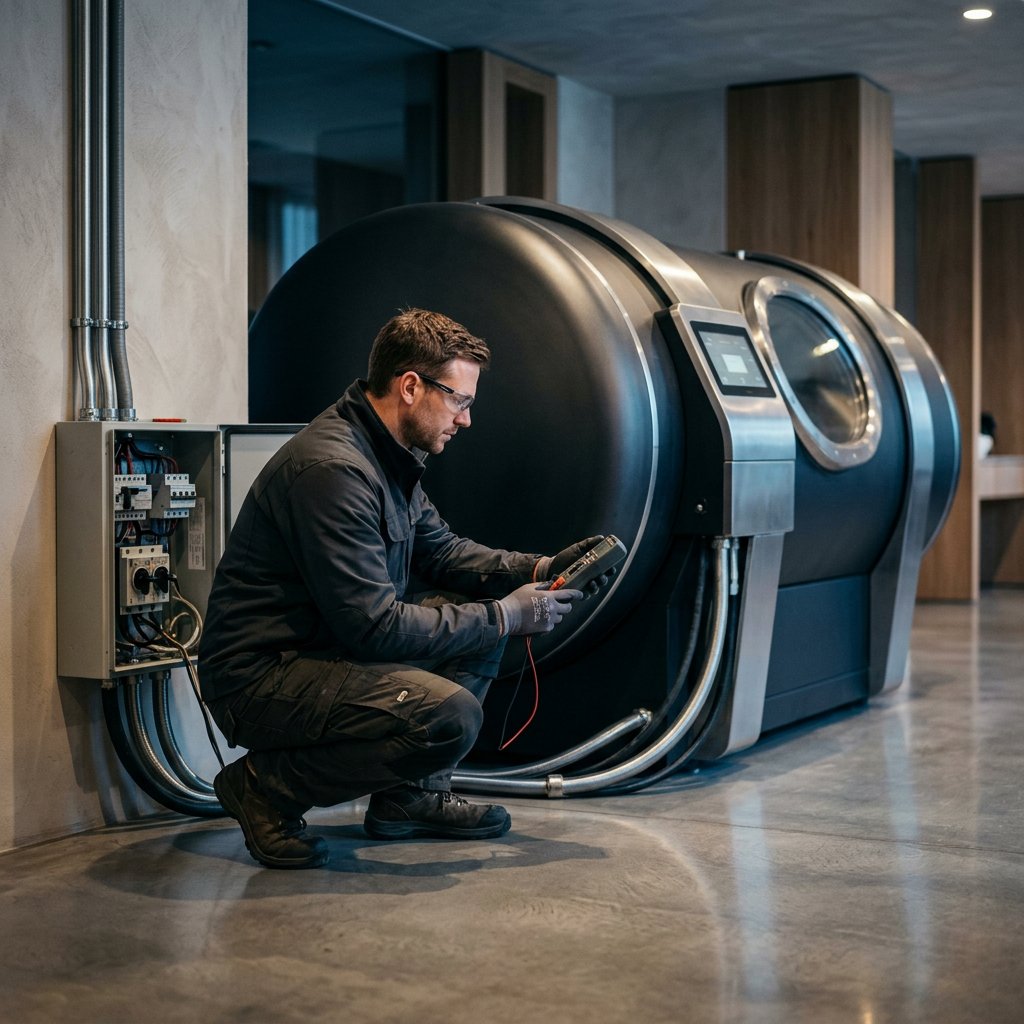
Hyperbaric Chamber Electrical Requirements
There is no single power specification that fits every hyperbaric chamber. Electrical requirements depend on the chamber type, the intended setting, and the manufacturer’s documentation for that exact model. In practice, planning is not only about supplying power. It is about reducing ignition risk in a pressurized, oxygen-sensitive environment. Below, you will see what to review for devices in and around the chamber, what room-side electrical items need checking, and what changes when a chamber is planned for home use. If you are comparing models, use a commercial hyperbaric chamber buying checklist to confirm voltage, amperage, and dedicated circuit needs before purchase.
Position your facility as a longevity destination.
In a 30-minute session, we'll assess which longevity and biohacking technologies fit your space, your clientele, and your business model — and which don't.
Arrange a ConsultationWhy power planning matters so much in HBOT
In HBOT, electrical setup is a fire-safety issue, not just an installation detail. The goal is to minimize ignition sources such as sparks, overheating, and unsuitable powered accessories. Requirements may become stricter depending on the chamber class, design, and operating environment, so the exact use case always matters.
Which electrical devices are actually okay in and around the chamber
Start with three separate questions: is the device permitted at all, is it truly necessary, and should it be inside or outside the chamber? Do not assume that standard medical, wellness, or consumer electronics are acceptable. The chamber documentation is the reference point. In most cases, fewer powered items inside means a safer, clearer setup.
Use equipment that is approved for hyperbaric conditions
Standard electronics are not automatically suitable just because they are common in clinics or wellness spaces. Any device used with the chamber should be appropriate for the pressure and oxygen-related environment and should not add ignition or combustion risk. Approval must be checked for the exact device, model, and intended use.
Keep in-chamber electronics to essential devices only
- Limit in-chamber powered devices to items required for chamber operation or patient care.
- Remove non-essential accessories that add risk without improving safety.
- Where possible, place controls and extra equipment outside the chamber.
- A simpler setup is easier to assess, manage, and review using a hyperbaric chamber maintenance checklist.
Review these device categories one by one
| Device category | Main risk concern | What to confirm |
|---|---|---|
| Motors | Heat, friction, sparking | Whether the exact motorized component is permitted for chamber use |
| Lighting | Heat build-up, unsuitable fittings | Whether the lighting system is specified for the chamber environment |
| Low-voltage equipment | False assumption of safety | That low voltage alone does not replace chamber-specific approval |
| Battery-powered devices | Stored energy, overheating, unknown compatibility | Whether the exact battery device is allowed by the manufacturer |
Check the room-side electrical infrastructure before commissioning
A chamber is only as safe as the room-side installation supporting it. Hyperbaric chamber electrical requirements include wiring, grounding, outlets, and switches working together as one safety system. Review the electrical plan before delivery and commissioning, using the supplier documentation, a qualified electrician, and a longevity equipment installation checklist.
Before going live, consider pre‑opening commissioning to validate electrical readiness and equipment performance.
How wiring and grounding help reduce ignition risk
Wiring should suit the chamber environment, not just general room expectations. Proper grounding or earthing is a core protection measure, not an optional extra. The installation should also account for moisture exposure, cable routing, connection quality, and overall build standard alongside the basic power supply.
What to review for switches and power outlets
- Check whether switch and outlet design is suitable for the planned environment.
- Review placement so spark risk is reduced around the chamber area.
- Consider moisture protection where relevant to the room setup.
- Confirm compatibility with the chamber’s specified power and installation requirements.
Can you put a hyperbaric chamber in your house?
Sometimes, yes, but it depends on the model, the room, and the available electrical setup. Portable or soft-shell units can differ significantly from hard-shell systems in site preparation and power needs; this is especially relevant when comparing hard-shell vs soft-shell hyperbaric chambers. Before buying for home use, confirm allowed accessories, placement, power supply, and whether a dedicated circuit or professional review is required.
What qualifications do you need to operate a hyperbaric chamber?
That depends on the chamber type and whether use is at home, in a commercial setting, or in a clinic. A correct electrical installation does not replace operator competence. Safe use still requires clear start-up, shut-down, and emergency procedures. Manufacturer training, commissioning, and operator checklists are important parts of long-term safety.