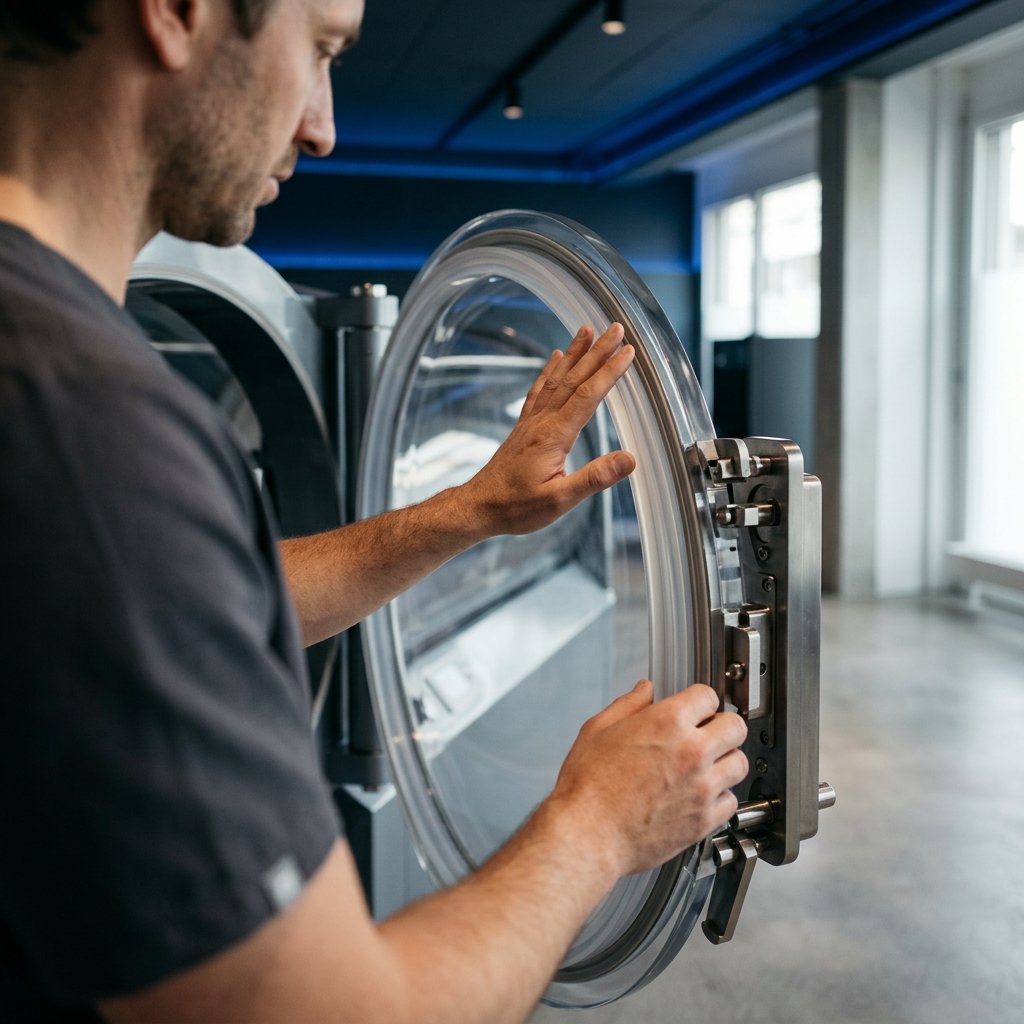
Safe chamber upkeep depends on four things: daily pre-use checks, careful cleaning, scheduled preventive service, and immediate escalation when something is off. The routine below focuses on the parts that affect safety and uptime most, including seals, shell or acrylic surfaces, gas supply, venting, grounding, and communication.
This is general guidance only. Your chamber manufacturer’s manual, service instructions, and facility safety rules always take priority.
Position your facility as a longevity destination.
In a 30-minute session, we'll assess which longevity and biohacking technologies fit your space, your clientele, and your business model — and which don't.
Arrange a ConsultationThe systems that matter most for safe chamber operation
A hyperbaric chamber works through controlled pressurization, prescribed gas delivery, safe venting, reliable sealing, and monitoring or communication. Maintenance therefore centers on pressure integrity, gas supply, ventilation, grounding, and emergency functions. Routine checks usually cover the shell or acrylic, door and gasket, hoses, valves, gauges, comms, and safety devices. Exact parts and procedures vary by manufacturer and by hard‑shell vs. soft‑shell hyperbaric chambers.
Daily pre-use checks to run before the first session
For day-to-day hyperbaric chamber maintenance, run this operator check for hyperbaric oxygen chambers before the first session.
| Item | Verify | Pass if | If not okay |
|---|---|---|---|
| Gas supply | Source connected; required supply available | Correct reading; enough supply; no leak signs | Stop use; replace, refill, or inspect |
| Hoses and exhaust | Routing, fittings, outlet path | No kinks, cracks, loose fittings, or blockage | Remove from service |
| Shell or acrylic | Interior and exterior surfaces | Clean, clear, no cracks, crazing, or impact damage | Stop use and assess |
| Door and gasket | Closure, seal surface, latch | Clean, seated, no cuts, closes evenly | Reseat or clean; if unresolved, stop use |
| Grounding and power | Cord, charger, ground status | Intact cable; normal status or function | Isolate and inspect |
| Safety locks or pins | Present and engaged as specified | Secure, complete, normal function | Do not operate |
| Ventilation and emergency vent | Normal and emergency response per SOP | Clear airflow; normal response | Take out of service |
| Communication | Intercom or call system | Clear two-way function | Do not start session |
| Air cylinders if used | Mounting, valve, fill or status | Secure and within required status | Replace or service before use |
Repeat these checks whenever chamber status changes, use is unusually heavy, or site policy requires another inspection.
Cleaning and disinfecting without damaging chamber materials
- Clean first, disinfect only when required, and use products approved for acrylic, seals, cushions, and accessories.
- Wipe interior contact surfaces between users; clean exterior touch points, gaskets, and add-on equipment at the end of the day.
- Avoid abrasive pads, harsh solvents, oversaturation, and dry rubbing; they can scratch acrylic, cause clouding or crazing, and shorten seal life.
- Schedule deeper cleaning on a planned basis aligned with OEM guidance and your infection-control rules.
What changes between hard-shell and portable chambers
| Aspect | Hard-shell focus | Portable or soft-shell focus |
|---|---|---|
| Structure and closure | Rigid vessel, door alignment, viewports, gaskets | Flexible shell, seams, closures or zippers, window panels |
| Supply and setup | Fixed gas, valves, gauges, room utilities | Compressor or portable supply, hose routing, setup stability |
| Site effects | Installation quality, room conditions, service access | Relocation, folding, storage, environment-related wear |
The goal is the same across chamber types, but readings, wear points, and service intervals are model-specific. If you are choosing chamber technology for a facility, HF Concepts supports manufacturer-neutral selection and integration, including a commercial hyperbaric chamber buying checklist; routine maintenance still follows the OEM documents for the exact model.
Who should handle daily checks, preventive service, and maintenance records
Operators can handle visual checks, status readings, basic cleaning, and log entries. Qualified service technicians, biomedical engineering teams, or the manufacturer should handle preventive service, calibration, repairs, and any work on pressure, oxygen-delivery, electrical, or life-safety components. Preventive intervals are usually set within a preventive maintenance plan for wellness technology, based on OEM guidance, chamber type, usage level, and facility requirements. Record the date, operator, readings, findings, actions taken, parts replaced, and sign-off. New, modified, or newly installed equipment should be reviewed and approved before routine use. For broader lifecycle planning to reduce downtime and extend chamber lifespan, see longevity equipment lifecycle management.
Signs it’s time to stop use and book a repair
Routine maintenance ends and hyperbaric chamber repair begins when any of these appear:
- Pressure is unstable, slow to build, or will not hold.
- You suspect leaks, repeated seal failure, or unusual hissing.
- Acrylic or shell shows cracks, crazing, deformation, or impact damage.
- Venting, communication, grounding, locks, alarms, or power behave abnormally.
- The same fault returns after normal daily checks.
Take the chamber out of service until a qualified repair partner or the manufacturer clears it. Early action usually reduces downtime, and complete logs make diagnosis faster. Do not attempt DIY fixes on pressure, oxygen-delivery, electrical, or emergency systems. If you need professional support for installation, servicing, or compliance, explore our hyperbaric oxygen chamber services.
Related questions about chamber use and treatment
These short answers cover common adjacent questions. They relate to patient experience, not routine equipment care.
How to prepare for a hyperbaric chamber?
Preparation usually means following your provider’s instructions on clothing, prohibited items, medications, and arrival time. You should also know how to equalize ear pressure during compression and decompression. Patient preparation is separate from chamber preparation, which the operator should finish before the session starts.
Is hyperbaric therapy painful?
It should not be painful, but pressure changes can cause temporary ear or sinus discomfort if equalization is difficult. Sharp pain or unusual distress should be reported immediately. On the equipment side, good seals, venting, and pressure control help sessions run smoothly.
Why am I tired after hyperbaric treatment?
Some people feel tired after a session, which is usually discussed with the treating provider as an individual response rather than a maintenance issue. Persistent fatigue or unusual symptoms need clinical follow-up. Chamber faults are more likely to appear as pressure, venting, communication, or alarm problems during operation.