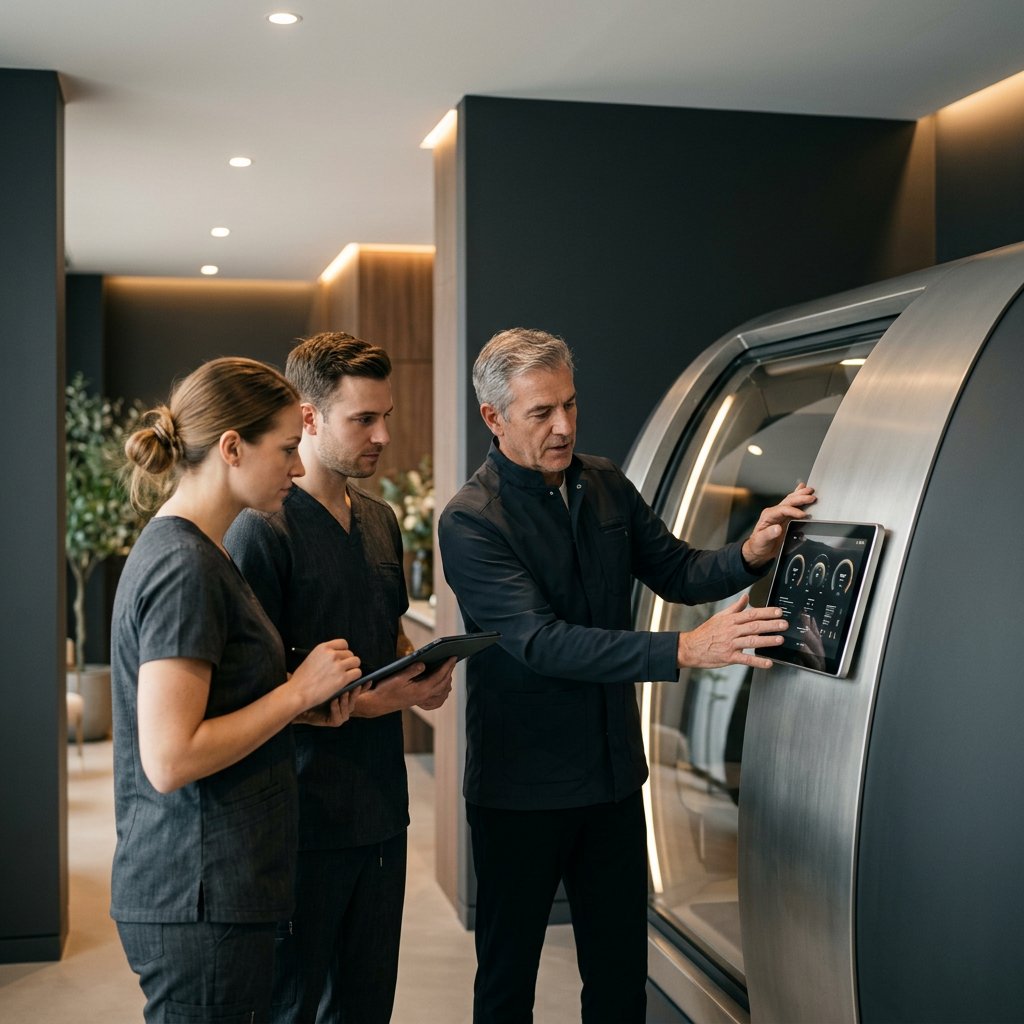
Wellness technology staff training framework
Wellness technology only becomes a repeatable, valuable service when your team can use it confidently in daily practice. Without that, even a well-chosen device can end up underused, handled differently from shift to shift, or treated as a risky add-on that only one person understands.
Effective training goes far beyond a device demo. It needs to cover workflows, safety boundaries, client handling, documentation, data responsibilities, escalation rules, and refreshers after launch. At HF Concepts, this is why training is part of Wellness technology integration rather than something left to chance after installation.
This framework shows how to structure training by role, embed it into real operations, and measure whether it is actually improving adoption, consistency, and business performance.
Position your facility as a longevity destination.
In a 30-minute session, we'll assess which longevity and biohacking technologies fit your space, your clientele, and your business model — and which don't.
Arrange a ConsultationWhy adoption depends on training, not the device alone
A new wellness technology does not create value on its own. Value appears when staff understand when a tool should be used, how it should be prepared and delivered, and where it belongs in the wider client journey. That includes everything around the session itself: booking, intake, handoff, documentation, follow-up, and the small operational decisions that shape consistency.
A common failure pattern looks deceptively simple. A facility installs a promising device, runs a generic launch session, and assumes the team will figure out the rest. A few enthusiastic staff members use it often, others avoid it, workflows drift, and clients receive different explanations depending on who is on shift. Usage then drops, confidence falls, and the technology never reaches the level of adoption expected at purchase.
Strong longevity training changes that pattern. It makes operations smoother, reduces hesitation at the point of delivery, and gives clients a more consistent experience. It also supports the business side: better utilization, fewer avoidable errors, clearer accountability, and less dependency on one “expert” operator. Just as important, leadership behavior sets the tone. If managers coach the process, review usage, and follow the same standards, training becomes part of how the service runs. If they treat it as a one-off event, the team usually does too.
Set the foundation before the first training session
- Define the exact technologies in scope and the workflows they belong to. Do not start with “the team needs training on the device.” Start with “this tool is used at intake, during recovery, or as part of a guided session,” because training only works when staff understand the operational context.
- Decide role by role what level of independence is allowed. Some tasks may be performed alone after sign-off, some only under supervision, and some not at all for certain team members. This prevents uncertainty and stops informal workarounds from becoming the real operating model.
- Translate training goals into observable outcomes. Each person should know what they must be able to explain, prepare, document, deliver, and escalate. Clear outcomes make sign-off practical and reduce the gap between “attended training” and “can safely perform the service on shift.”
- Set operating standards early. That includes SOPs, contraindications, hygiene steps, start-up and shut-down routines, escalation rules, documentation requirements, a preventive maintenance plan, and handoff points between front desk, operators, managers, and any clinical or compliance lead involved.
- Assign one internal training owner and connect external support to that person. If a supplier or an independent integrator such as HF Concepts is involved in installation, commissioning, operator checks, or a Team briefing for longevity equipment, those steps should be mapped into one rollout plan so nothing gets lost after delivery.
Train by role, not just by machine
| Role | Main training focus | What sign-off should confirm | Access format |
|---|---|---|---|
| Front desk or advisory staff | Booking logic, client questions, screening prompts, consent handoff, and service positioning | They can guide clients correctly without overselling or creating confusion | Short mobile modules, shift huddles, and quick-reference scripts |
| Operators or therapists | Setup, session delivery, hygiene, stop criteria, documentation, and room turnaround | They can run sessions consistently and escalate when needed | Hands-on practice, supervised sessions, and room-based checklists |
| Managers | Coaching, staffing, utilization checks, incident review, and refresher planning | They can reinforce standards and spot drift early | Operational dashboards, shadowing, and coaching templates |
| Clinical or compliance lead | Contraindications, documentation standards, privacy rules, and escalation pathways | They can govern the service safely across multiple devices | Formal review, audit checks, and policy sign-off |
Put training inside real operating workflows
Training works best when it mirrors the way the service actually runs. That means mapping learning to booking, intake, consent, setup, session delivery, follow-up, and documentation instead of teaching the technology in isolation. When staff only learn device features, they miss the moments where most friction appears: who checks suitability, who explains the process, where notes are recorded, and how the next team member picks up the case.
Consistency also improves when training resources are easy to reach during work, not buried in long manuals or desktop folders. Centralized SOPs, room-based checklists, mobile-friendly guides, and simple digital access help teams working across different rooms, schedules, or sites. This matters even more for non-desk and shift-based teams who do not learn best through office-hour presentations. For a clear step-by-step template your team can adapt, see HRV measurement protocol.
Hands-on practice should sit at the center of the framework. Supervised sessions, scenario-based learning, and pilot runs are far more useful than manual-heavy training that ignores real client flow. In facilities using several technologies, training should also include scheduling several devices and sequencing: what happens first, how long room turnaround takes, when diagnostics feed into therapy or recovery steps, and where responsibility moves from one team member to another. For an example treatment workflow useful for procedure training and QA, see IHHT therapy workflow for commercial wellness centers.
Cover safety, privacy, and escalation before advanced features
- Teach the non-negotiables first: contraindications, intended operating limits, hygiene routines, start-up and shut-down checks, maintenance observations, and the conditions that require a session to pause, stop, or escalate. For high‑risk modalities, refer to Cryotherapy chamber safety standards.
- Make consent and documentation part of training from day one. Staff should know what must be explained, what needs to be recorded, and how handoffs work when a case moves beyond standard service delivery.
- Where wearables, dashboards, questionnaires, or connected systems are used, train staff on privacy, cybersecurity, access control, and responsible handling of health-related information in line with your internal policies and applicable regulations.
- Advanced automation can support decision-making, but it should not replace human judgment. If a system produces prompts or recommendations, staff still need clear escalation rules and a defined person responsible for final decisions.
Measure competence, adoption, and business impact separately
| What to measure | How to measure it | What it tells you |
|---|---|---|
| Competence | Observed checklists, supervised sessions, and formal sign-off instead of attendance alone | Whether staff can actually perform the workflow safely and consistently |
| Adoption | Real usage data, completed sessions, workflow compliance, and repeat use by trained staff | Whether training changed daily behavior after launch |
| Business impact | Consistency of delivery, staff friction, utilization, service flow, and retention where relevant | Whether the service is becoming sustainable and easier to run |
| Review loop | Scheduled updates when devices, staffing, systems, or the service menu changes | Whether training stays current instead of aging out after rollout |
Common mistakes that quietly undermine training
- Running a one-off launch session and calling it done. Generic presentations may create short-term enthusiasm, but they rarely change how people work when the room is busy and decisions need to be made fast.
- Designing the program without managers, frontline teams, or shift workers. Adoption often breaks where access is weakest, ownership is unclear, or the people doing the work were never part of the setup.
- Making training too complicated. Overloaded tools, dense manuals, and heavy jargon create distance from the service instead of confidence inside it. Staff need practical steps that fit real workflows.
- Ignoring the leadership credibility gap. If supervisors bypass the process, overload the team, or never review the standards themselves, staff quickly learn that the training is optional no matter what the slides said.
A simple 90-day rollout plan for new wellness technology
| Timeline | Main focus | Practical actions | Partner and launch sync |
|---|---|---|---|
| Days 1-30 | Build the operating foundation before live use | Map roles, review risks, define SOPs, set sign-off criteria, prepare checklists, create quick-reference materials, and agree what success looks like for competence, adoption, and utilization. | Align installation, Pre-opening commissioning for longevity facilities, operator checks, and team briefing dates with the internal rollout plan so training starts before the service goes live. |
| Days 31-60 | Move from theory into supervised operation | Onboard each role, run supervised sessions, test booking and intake flow, launch pilot usage, collect staff feedback, and fix friction points around handoffs, room setup, and documentation. | Use supplier or integrator input to validate technical setup while your internal owner tracks whether the workflow works under real operating conditions. |
| Days 61-90 | Stabilize, review, and improve | Review usage patterns, incidents, client flow, and staff confidence; compare trained versus active users; identify weak spots; then convert the findings into refreshers, updated SOPs, and coaching priorities. | Close the first rollout cycle only after operational learning is folded back into the service, so training supports the full launch instead of trailing behind it. |