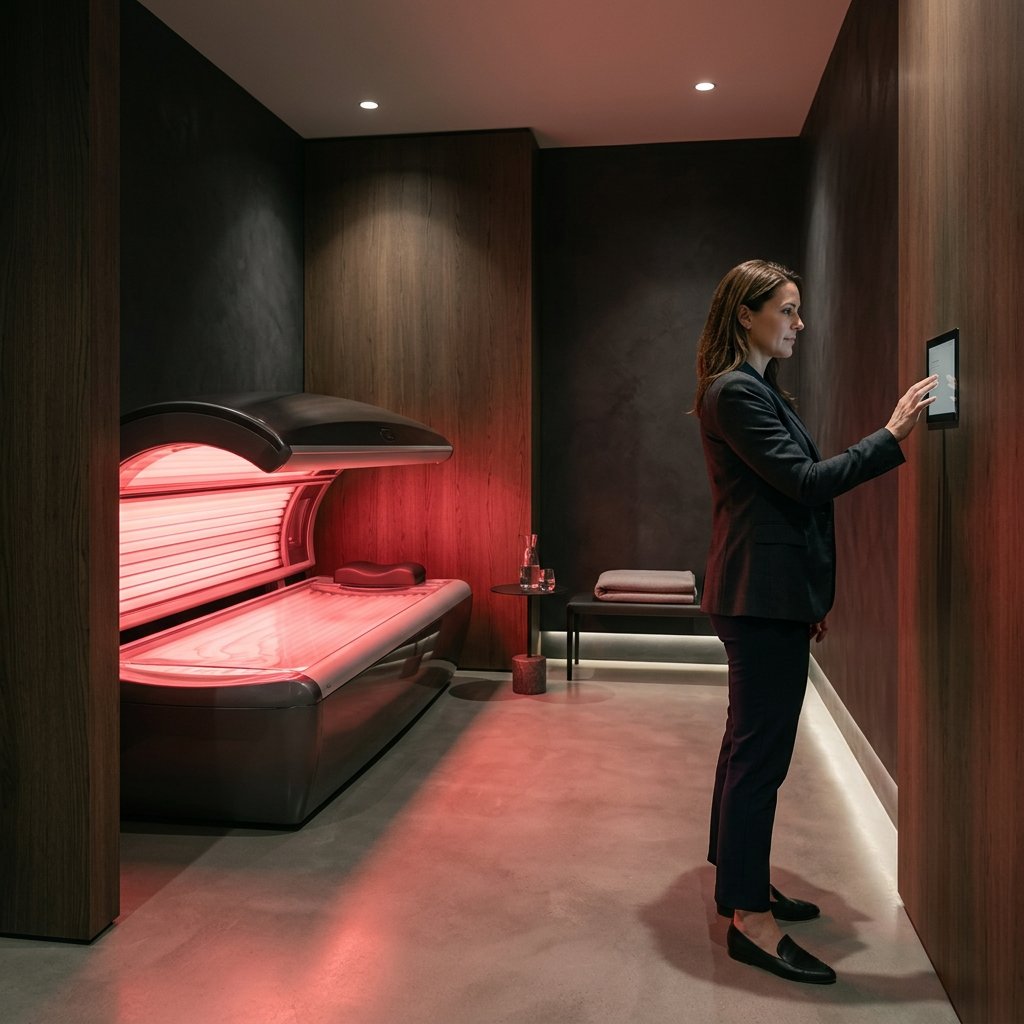
Red light therapy bed business model
A red light therapy bed can be a strong premium add-on for wellness, recovery, beauty, and longevity concepts, but the business case depends far more on fit, utilization, and implementation than on hype. In the right setting, a full-body photobiomodulation session offers broad coverage in one appointment and can simplify client flow compared with formats that need more repositioning.
That does not mean a bed is the right answer for every operator. A tanning studio, hotel spa, fitness recovery space, beauty concept, and longevity center all work with different room constraints, staffing models, pricing logic, and claims boundaries. Use this guide to assess whether a full-body bed belongs in your concept, what really drives profitability, and what to verify before you invest. If you are comparing specific models, explore our red light therapy beds for sale.
Position your facility as a longevity destination.
In a 30-minute session, we'll assess which longevity and biohacking technologies fit your space, your clientele, and your business model — and which don't.
Arrange a ConsultationWhere a full-body PBM bed fits in your offer
The main commercial advantage of a full-body bed is simple: broad body coverage in one session, with less repositioning and smoother client flow.
| Business setting | Why a bed can fit | When another format may fit better |
|---|---|---|
| Wellness or beauty studio | Premium full-body session for skin appearance and general well-being. | Panels if space is tight or treatments are more targeted. |
| Recovery or fitness space | Fast client turnover and easy inclusion in recovery routines. | Panels or recovery-room equipment for mixed-use zones. |
| Longevity clinic or center | Fits a broader protocol-led wellness offer. | Localized devices when programs are more individualized. |
| Hotel spa | Creates a premium guest experience with low-touch operation. | Smaller formats when room planning is restrictive. |
| Tanning salon red light therapy add-on | Familiar bed format can support adoption. | Panels if you want a gradual shift away from UV-led expectations. |
What really drives the business case
The economics of a red light therapy bed business are rarely decided by purchase price alone. What matters more is utilization, pricing strategy, and how many sessions you can run without overestimating turnover. Operators typically monetize the offer through standalone sessions, memberships, bundles, or as a premium add-on inside a wider wellness or longevity concept.
Short, low-touch sessions can support attractive throughput, but only if booking flow, client briefing, cleaning time, and staffing are planned realistically. The acquisition model matters too: buy, lease or rent wellness equipment — each changes cash flow and payback timing. Break-even should be modeled from fixed costs, electricity, service, and expected demand. For this reason, HF Concepts evaluates PBM beds in the context of the wider concept, not as an isolated device purchase.
Which outcomes are realistic to position in a commercial offer
Businesses most often position red light therapy beds around recovery support, skin appearance, musculoskeletal comfort, relaxation, sleep, and general well-being. Those are the benefit areas customers usually understand best, but the evidence is not equally strong across every use case, protocol, wavelength mix, or device design. Results shown with localized PBM devices do not automatically transfer to a full-body bed.
That distinction matters for menus, staff scripts, and expectation-setting. Language such as “supports recovery” or “promotes relaxation” is different from implying treatment of a medical condition. A strong commercial offer explains what the session is intended to support, how the experience works, and that outcomes vary by individual, protocol, and device parameters. Clear, conservative framing builds more trust than exaggerated promises.
The operational checklist before you buy
- Check the exact model footprint, access route, door width, turning radius, ceiling height, clearance, and ventilation needs before you approve the room.
- Verify power supply, voltage, breaker requirements, operating cycles, cooling demands, and the daily session volume the unit is designed to support.
- Plan delivery, installation, commissioning, and any site preparation required before the bed arrives.
- Define who handles first-use instruction, cleaning between clients, hygiene checks, and turnover timing during busy hours.
- Confirm service access for maintenance or repairs, including whether the unit can be opened, moved, or serviced in place.
- Use model-specific technical data for planning; generic “commercial-grade” wording is not enough.
For a ready-to-use prelaunch and daily-operations review, use our operator checklist for red light therapy.
How to compare commercial beds without falling for headline specs
- Assess wavelength mix in relation to intended use instead of assuming that more colors or more LEDs automatically mean a better device.
- Compare irradiance only when measurement distance, treatment position, and test method are clearly stated.
- Look beyond peak numbers and ask how uniform the light coverage is across the body in real treatment positions.
- Review thermal management, repeat-use consistency, session controls, presets, user lockouts, and emergency-stop features.
- Request exact-model documentation, optical specifications, and the measurement methodology behind performance claims.
- Be cautious with broad certification language if it is not tied to the exact model you are buying.
For vendor selection and side-by-side specs, see our comparison of Halocab, RedWave, Halored and Lumivera.
Claims, safety, and compliance: what you need to get right
Your compliance burden depends heavily on intended use and marketing language. A bed positioned for general wellness, relaxation, recovery support, or skin appearance is not the same as a bed promoted with stronger therapeutic claims. In the EU, the exact model, its documentation, and the claims used in the target market all matter under CE and MDR-related requirements. General brand statements or “medical-grade” wording do not replace exact-model evidence.
Operational safety also has to be built into everyday use. Follow the eyewear guidance for the specific unit, screen for photosensitivity or other relevant flags according to supplier instructions, define clear stop rules for discomfort, and train staff on first-use briefing and incident handling. Keep model-specific optical and safety records, commissioning documents, and operating instructions together. If you collect screening or client-use information, handle it in line with GDPR. And if the installed unit differs from the tested or documented version, validation and supporting paperwork may need to be updated before launch.
Bed vs panel vs tanning bed: choose the right format
| Format | Commercial strengths | Trade-offs | Best fit |
|---|---|---|---|
| Full-body PBM bed | Broad coverage, minimal repositioning, premium session feel, efficient high-volume workflow. | More floor space, more complex delivery and installation, higher commitment per room. | Operators wanting premium full-body sessions and smooth client flow. |
| PBM panel | Flexible setup, smaller footprint, easier use in mixed recovery zones. | More repositioning, less “bed-like” premium experience for some customers. | Studios, gyms, and centers with tighter space or more targeted protocols. |
| Handheld or localized device | Portable, targeted, useful for specific body areas and add-on use. | Low body coverage and more staff involvement per session. | Localized protocols or supplementary treatment menus. |
| UV tanning bed | Familiar format in tanning environments. | Different light source, mechanism, risk profile, customer expectation, and compliance language; not a PBM substitute. | Only relevant as a comparison point when repositioning a tanning-salon offer. |
If you are adding PBM to a tanning environment, it is not just a lamp swap. Positioning, protocols, staff explanations, and customer education all need to change with the technology.
What to ask a supplier before you sign
- What level of commercial use is this exact model designed for, and what daily throughput is realistic?
- What session programs, presets, lockouts, and user controls are built in for staff-managed operation?
- What are the exact installation requirements for room size, power, clearance, ventilation, and access?
- What cleaning steps are required between clients, and what maintenance tasks should operators expect weekly or monthly?
- What commissioning support, staff training, and onboarding materials are included at launch?
- What warranty terms apply, how is service handled, what spare parts are available, and what are the response times?
- Can you provide exact-model performance documentation, measurement methods, optical data, safety records, and market-specific compliance evidence?
- What are the lead times, financing or rental options, and how does this unit fit a wider recovery, wellness, or longevity concept?
Common questions from commercial buyers
Do red light therapy beds really work in a commercial setting?
They can, when the use case, protocol, and customer expectations are aligned. A bed may work well as a premium recovery, wellness, or skin-focused service, especially when full-body coverage and simple client flow matter. But commercial success does not come from claims alone. Utilization, pricing, room economics, staff briefing, and realistic expectation-setting usually influence results just as much as the technology itself.
Is a full-body bed better than panels for your business?
Not automatically. A full-body bed is strong when you want broad coverage, minimal repositioning, and a premium session format. Comparing professional vs consumer red light panels can be useful when floor space is tighter, protocols are more targeted, or you want more flexibility in a recovery room. The better choice depends on your layout, treatment menu, staff time, and price point. In some concepts, a mixed setup delivers the best operational and commercial balance. For an overview of pro-grade options and support, see commercial red light therapy equipment.
How long is a typical session, and how many can you run in a day?
There is no universal session length. It depends on the exact model, output, protocol, intended use, and supplier instructions. Daily capacity should also never be based on session time alone. You need to account for changing, first-use briefing, cleaning, booking gaps, staffing, and any cooldown or operating limits. A schedule that looks efficient on paper can break down quickly in live operation, especially during launch. For revenue planning, use conservative capacity assumptions and test several break-even utilization for wellness equipment scenarios before making payback claims or setting membership targets.
Do clients need eye protection, and what should they wear?
Follow the instructions for the exact model. Eye protection may be required or recommended, and near-infrared exposure is not fully visible, so staff should not rely on comfort alone. Clothing should leave the intended skin areas exposed while still matching your privacy, hygiene, and venue policy. Before a first session, explain positioning, expected comfort, hygiene rules, and when the client should stop the treatment and alert staff.
Can you market a bed as medical-grade?
Be careful with that term. “Medical-grade” is not a shortcut to permission for stronger claims. What matters is the intended use, the regulatory status and documentation of the exact model in your target market, and the evidence supporting your messaging. Do not borrow claims from other red light therapy equipment or general studies if the bed is positioned differently. If therapeutic claims are central to the business model, get compliance advice before launch.