
 Electric cryo chamber
 Thermal contrast
 Ice bath 2.0
 Dry Floating
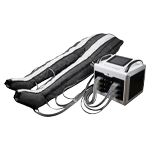 Lymphatic drainage
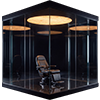 Multisensory Regeneration Cabin
 IHHT altitude training
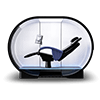 HBOT Oxygen chamber
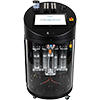 Water Plasma Application
 Red Light Therapy
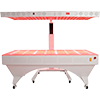 Photobiomodulation
 Cell regeneration
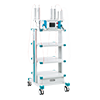 Endolaser
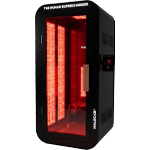 HaloCab Human Supercharger
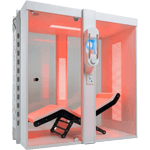 Salt & Red Light
 Vibroacoustics
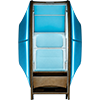 Magnetic Field Applications
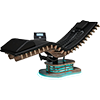 Back therapy system
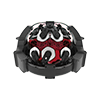 WeberBrain
 Pelvic floor training
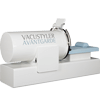 iFlow® IVT Therapy
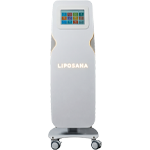 Frequency ultrasound
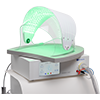 Dermio Care Plus
 Lounge equipment
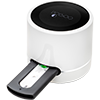 Health of Point Diagnostics
 Body analysis
 FRAS 5
 Mobile HRV measurement


Short answer
A longevity technology reaches break-even when the contribution margin of all sessions covers monthly fixed costs. The formula is: break-even sessions per month = monthly fixed costs ÷ (price per session − variable cost per session). The calculation only becomes realistic when you use actual demand instead of theoretical capacity, rebooking rates instead of first visits, and a ramp-up period of several months.
At a glance
Formula
fixed costs ÷ margin per session
Most common mistake
confusing capacity with demand
Most underestimated
staff minutes per session
Strongest lever
rebooking / membership
Plan for ramp-up
several months of liquidity
What is the utilization trap?
The typical sales calculation looks like this: 10 opening hours, 3 sessions per hour, 25 days a month. That’s 750 possible sessions. Even at 20 % utilization, the device pays for itself in no time. The math is correct, and commercially worthless.
Because it answers the wrong question. Capacity tells you how many sessions are possible. Your success depends on how many people actually book and how often they return. I call this gap the utilization trap. It appears on no manufacturer’s invoice, and it’s the biggest risk in the longevity business.
The break-even formula and what really goes into it
Break-even sessions per month = monthly fixed costs ÷ (price per session − variable cost per session)
| Cost type | What’s included | Often forgotten |
|---|---|---|
| Fixed costs | financing or depreciation, floor space share, service and maintenance, insurance, software | marketing budget, training, downtime reserve |
| Variable costs | staff minutes, consumables, hygiene, payment fees | consultation before the first session, no-shows |
The most underestimated factor is staff time. Measure minutes per session, not minutes per treatment: greeting, suitability check, onboarding, cleaning and follow-up all count.
Three thinking errors that make every forecast look better
- Capacity instead of demand: opening hours are not bookings. Calculate with the number of clients you can realistically win in your catchment area.
- First visits instead of rebookings: trying something once is marketing. Only the rebooking rate turns a device into a business model.
- Day one instead of ramp-up: no offer starts at full utilization. Plan several months of ramp-up and the liquidity to cover them.
Scenario: how many clients do you really need?
Illustrative scenario based on assumptions. Not a real client case, no guarantee.
| Item | Assumption |
|---|---|
| Financing / depreciation | €1,100 / month |
| Floor space share (12 m² × €25) | €300 / month |
| Service and insurance | €150 / month |
| Software and marketing share | €150 / month |
| Total fixed costs | €1,700 / month |
| Net price per session | €45 |
| Variable costs (10 staff minutes at €0.50, consumables €2, payment €1) | €8 |
| Contribution margin per session | €37 |
| Break-even | €1,700 ÷ €37 = 46 sessions / month |
46 sessions are just 6 % of the theoretical capacity of 750. Sounds harmless. The real question is how many clients those 46 sessions come from:
| Revenue model | Visits per client / month | Active clients needed |
|---|---|---|
| Single session, no commitment | approx. 1.5 | 31 clients, constantly re-acquired |
| Package (10-session card) | approx. 2.5 | 19 clients |
| Membership (€149, up to 4 sessions) | up to 4 | 15 members* |
*For memberships, break-even is calculated from the margin per member: €149 − 4 × €8 = €117; €1,700 ÷ €117 = 15 members. The same technology needs either 31 clients who must be won again every month, or 15 members who stay. Membership beats single sessions, in almost every facility type.
How to make your calculation robust
- Run sensitivities: what happens with a 30 % lower price or 50 % lower utilization?
- Measure staff minutes: in a showroom or trial phase, don’t estimate.
- Test the rebooking rate: with a pilot group before you extrapolate.
- Plan the ramp-up: budget liquidity for the first months separately.
- Back it with a marketing plan: without a plan for where clients come from, every utilization forecast is fiction.
Four KPIs to track from month one
| KPI | Why it matters |
|---|---|
| Utilization of bookable slots | shows real demand instead of opening hours |
| Rebooking rate | decides whether you retain clients or constantly acquire new ones |
| Contribution margin per session | exposes discounts and staff time |
| Revenue per m² | compares technologies fairly |
Frequently asked questions
How do I calculate break-even for wellness or longevity equipment?
Divide monthly fixed costs by the contribution margin per session, which is price minus variable costs. The result is the minimum number of sessions you need to sell per month.
What utilization is realistic?
There is no universal number. It depends on location, target group, price and marketing. A professional approach uses several scenarios and a ramp-up period rather than a single percentage.
How long does it take for longevity equipment to pay for itself?
That depends on the surplus above break-even. If you barely reach break-even, payback is slow. If memberships and rebookings put you well above it, payback is much faster.
Are memberships better than single sessions?
In almost every facility type, yes, because recurring use creates predictable revenue and requires fewer new clients. Single sessions work well as an entry point into a membership.
Which costs are most often forgotten?
Staff minutes per session, consultation time before the first appointment, marketing budget, training and a reserve for downtime.
Transparency: HF Concepts sells some of the technologies discussed here. That’s why we assess against clear criteria and advise against a purchase when the fit is missing.
Note: All information is general, non-medical information. The applications discussed are wellness and recovery applications and do not replace medical advice.